
Running a company involves wearing many hats, and figuring out how to get found online often falls to the bottom of the list. However, mastering small business SEO is one of the most effective ways to ensure sustainable growth without blowing the budget on ads every month. Many owners think business search engine optimization requires a massive team or expensive software, but the reality is quite different.
With the right strategy, you can compete with larger brands by focusing on specific, high-intent searches that drive revenue rather than just vanity metrics. At Occam Digital, we believe that effective digital marketing should be accessible and straightforward. This guide breaks down exactly how to approach SEO for small businesses in a way that is manageable, impactful, and designed to fit into a busy schedule.
How SEO Can Help Small Businesses in 2026
The digital landscape shifts rapidly, but the core value of SEO for small businesses remains constant. In 2026, search engines are prioritizing experience, authority, and genuine helpfulness over technical tricks. For a smaller company, this is good news. It means that deep expertise and customer care can outrank a big brand with a generic content strategy. That’s why many small businesses invest in content & copywriting that turns what they know into clear pages people actually want to read, and Google wants to rank. Investing in small business SEO marketing allows you to build a digital asset that works for you twenty-four hours a day, unlike paid ads that stop the moment you pause funding.
What Real SEO Results Look Like for Small Businesses
Many SEO for business owners guides focus on vanity metrics like impressions, but real success looks different. It appears as a steady stream of qualified leads, a ringing phone, or appointments booking up weeks in advance. True success involves moving away from the feast or famine cycle of referrals and establishing a predictable revenue channel. When you analyze documented success stories, the pattern is clear. The goal is not just being seen but being seen by the right people at the exact moment they are ready to buy.
Key Business Problems SEO Can Solve
Effective business search engine optimization does more than just rank pages. It solves fundamental operational problems. If you are struggling with high customer acquisition costs, SEO provides a lower cost per lead over time. If your brand lacks trust compared to established competitors, high rankings signal authority and reliability to potential customers. Implementing strategic search optimization can also smooth out seasonal dips by capturing demand from different stages of the buying funnel, ensuring you are not solely reliant on word of mouth or expensive outbound sales.
Is It Different from Local SEO?
This is a common question in every small business SEO guide. While general SEO focuses on ranking nationally or globally for informational terms, local SEO is hyper-focused on capturing demand in a specific geographic area. For a plumber or a coffee shop, local signals are the priority. However, a holistic approach combines both. You want to appear in the “map pack” for local searches while your website content ranks for broader questions your customers are asking. Small business SEO help often starts with mastering your local presence before expanding into broader organic strategies.
Before You Start: What You’ll Need to Succeed
Embarking on a journey to improve your search visibility does not require a massive budget, but it does require the right mindset and a few essential assets. Successful small business SEO is built on preparation and consistency. Jumping in without a plan often leads to wasted effort on tasks that do not move the needle.
Set Realistic Expectations for SEO Growth
One of the most important SEO tips for small businesses is to understand the timeline. Unlike paid advertising which turns on traffic instantly, organic growth is a compound effect. You might not see significant traffic changes in the first month. However, the authority you build today pays dividends months and years down the line. It is crucial to view this as a long-term investment in your brand infrastructure rather than a quick fix for a slow sales month.
Key Tools You’ll Use (All Free)
You do not need expensive enterprise software to get started. Google provides the most powerful data directly through Google Search Console and Google Analytics. These free platforms tell you exactly how people are finding you and where they are dropping off. For business owners looking to generate momentum early, focusing on accessible quick wins using these free tools can provide motivation while the longer-term strategy takes root.
Pre-Audit Setup Checklist
Before writing new content or building links, you must ensure your website is technically sound. If you want a faster, more reliable way to confirm everything is set up correctly, our technical SEO services can audit your site’s crawlability, speed, and key technical issues before you invest in content or links. If search engines cannot crawl your site effectively, your content efforts will be invisible. We recommend running through a comprehensive technical SEO checklist to identify any structural barriers. This includes verifying that your site is mobile-friendly, loads quickly, and is free of major crawl errors. This foundational work ensures that every subsequent hour you spend on small business SEO help yields the maximum possible return.
Small Business SEO Checklist (Step-by-Step)
Breaking down business search engine optimization into a step-by-step process makes a massive project feel manageable. Instead of trying to do everything at once, follow this logical flow to build a solid foundation. This checklist covers the essentials that drive the most impact for growing companies.
1. Set Up Google Search Console and Google Analytics
You cannot improve what you do not measure. Google Search Console is the only way to see exactly what Google thinks of your website, while Google Analytics 4 tracks user behavior. Setting these up gives you immediate visibility into technical errors and organic traffic sources.
2. Claim and Optimize Your Google Business Profile
For local companies, your Google Business Profile can be just as important as your homepage. Claiming this listing ensures you show up in Maps and local searches. Fill out every section, including your description, hours, and photos. An optimized profile is a cornerstone of small business seo marketing because it connects you directly with nearby customers.
3. Do Basic Keyword Research for Your Products or Services
Stop guessing what your customers type into the search bar. Use tools to find terms with search volume that match your services. Good SEO tips for small businesses always emphasize intent over volume. It is better to rank for “emergency plumber near me” than just “plumbing history.” If you want to learn exactly how to uncover these hidden opportunities, our comprehensive SEO training breaks down the research process in detail.
4. Optimize Core Pages (Home, About, Services)
Once you have your keywords, map them to your main pages. Include the primary keyword in your page title, main header (H1), and naturally within the body text. However, avoid forcing it. The content must still read naturally for humans.
5. Add Local SEO Signals (NAP, Directories, Reviews)
NAP stands for Name, Address, and Phone number. Ensure this data is identical across your website, social media, and local directories like Yelp or Yellow Pages. Inconsistent data confuses search engines and hurts your rankings. Encouraging happy clients to leave reviews reinforces these signals and builds social proof.
6. Create Simple, Helpful Blog Content Regularly
You do not need to be a media publisher, but you do need to answer your customers’ questions. Write articles that address common problems, industry misconceptions, or “how-to” guides related to your product. This establishes authority and captures searchers who are looking for information before they are ready to buy.
7. Build Easy Backlinks (Partnerships, Citations, Mentions)
Backlinks act as votes of confidence from other websites. Start with the low-hanging fruit. Ask suppliers, business partners, or local organizations you sponsor to link to your site. High-quality small business SEO help often involves identifying these existing real-world relationships and digitizing them. If you’d rather not guess which sites and mentions are worth pursuing, our link building & off-page SEO services focus on earning relevant placements that actually move rankings and referral traffic.
8. Fix Basic Technical SEO Issues (Broken Links, HTTPS, Speed)
A slow or broken site drives visitors away. Use your audit tools to find and fix 404 errors and ensure your site is secure (HTTPS). A clean, fast technical foundation helps Google crawl your site without hitting dead ends.
9. Track Progress with Simple Metrics (Traffic, Rankings, Leads)
Review your data monthly. Look for upward trends in organic traffic and keyword rankings. More importantly, track how many leads or sales come through organic search. Sometimes, comparing organic results with paid advertising data can highlight which keywords convert best, allowing you to refine your strategy.
What You Can Do vs. When to Get Help
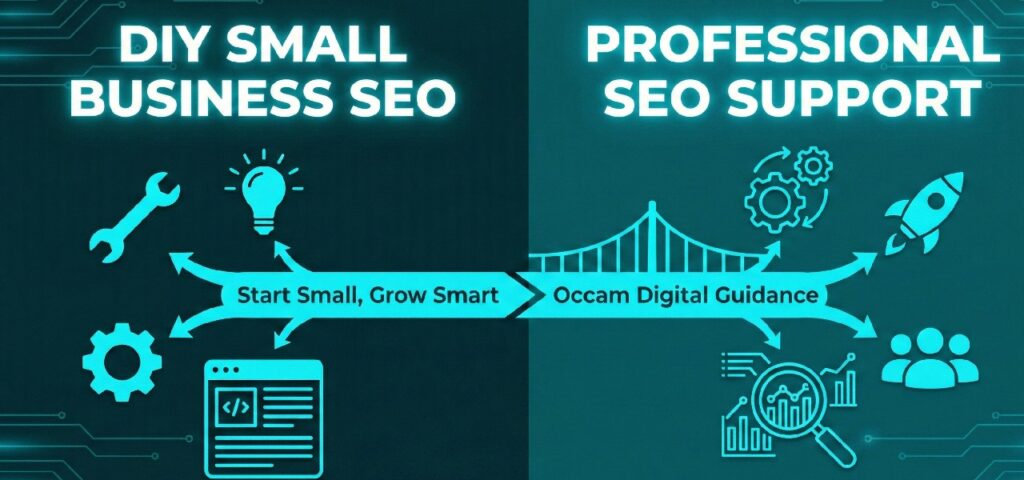
Deciding between handling small business SEO yourself or hiring an expert is a pivotal choice. Many entrepreneurs start with a DIY approach to save cash, which is a smart move in the early stages. However, as your company grows, the complexity of managing a competitive digital presence often outpaces the time you have available.
What Most Small Businesses Can DIY
You are the expert on your product and your customer. This means you are actually the best person to handle the content side of SEO for small businesses. No agency understands your brand voice or customer pain points better than you do. Tasks like writing blog posts, updating your Google Business Profile, and asking satisfied clients for reviews are perfect DIY activities. These tasks require consistency and industry knowledge rather than technical coding skills.
When It Makes Sense to Work With an SEO Agency
There comes a tipping point where small business SEO help becomes necessary. This usually happens when technical issues prevent your site from ranking, or when you are in a highly competitive market where basic optimization is not enough. If you need to migrate to a new website platform, recover from a penalty, or scale your content production significantly, professional support ensures these high-risk moves are handled correctly. Furthermore, understanding the synergy between paid and organic strategies often requires advanced data analysis that an agency can provide.
DIY vs Agency SEO: What’s Right for You?
To help you decide, compare your current resources against your growth goals. If you have more time than money, DIY is the way. If you have budget but no time, outsourcing is safer.
Comparison Table: Budget, Expertise, Time Investment
| Factor | DIY SEO | Professional Agency |
| Budget Cost | Low (mainly time & tools) | Moderate to High (monthly retainer) |
| Time Required | High (5–10 hours/week) | Low (1–2 hours/month for strategy) |
| Expertise Needed | You must learn as you go | Immediate access to experts |
| Speed of Results | Slower (learning curve) | Faster (proven strategies) |
| Risk | Moderate (accidental errors) | Low (accountability) |
Occam Digital’s Support Options for Small Teams
We understand that SEO for business owners is not one-size-fits-all. Some teams need full-service management, while others just need a roadmap to follow themselves. We offer flexible options designed to meet you where you are. Whether you need a one-time audit to steer you in the right direction or a dedicated partner to handle the heavy lifting, contacting our team helps us determine the most efficient way to achieve your growth targets.
Common SEO Mistakes Small Businesses Make
Even with the best intentions, it is easy to fall into traps that hinder your progress. The internet is full of outdated advice, and following the wrong steps can actually hurt your rankings. Successful small business SEO requires avoiding these common pitfalls to ensure your hard work translates into actual revenue.
Ignoring Local SEO Basics
A frequent error in small business SEO marketing is trying to compete on a global stage when your customers are right down the street. If you run a local bakery or a dental practice, ranking for broad terms like ‘best cakes’ or just ‘dentist’ is extremely competitive and usually not the best use of your budget compared to more specific, local searches. Neglecting your local signals means you miss the high-intent customers searching for services in your specific area. Focus on capturing the local market first before trying to expand your reach.
Keyword Stuffing or Copying Competitors
Years ago, you could rank by jamming a keyword into a page fifty times. Today, that tactic will likely hurt your rankings and can trigger spam filters. SEO tips for small businesses often warn against “keyword stuffing” because it ruins the user experience. Similarly, copying content directly from a competitor confuses search engines about which version is the original, usually resulting in the older site winning while yours is ignored. You must create unique, valuable content that speaks directly to your audience.
Not Tracking Results or Quitting Too Early
Business search engine optimization is not a switch you flip on. It is a garden you water. Many owners give up after three months because they do not see a massive spike in sales. This premature exit is the biggest reason campaigns fail. Without tracking data properly, you might stop a strategy right before it starts gaining traction. Patience and consistent monitoring are the only ways to win the long game.
FAQs About Small Business SEO
Is SEO a Good Business Strategy for My Small Business?
Yes. Unlike ads that stop when payment stops, SEO builds a permanent asset. It establishes trust because customers view organic results as credible recommendations. This strategy lowers your customer acquisition costs significantly over the long term.
How Long Does It Take to See Results?
For most small businesses, it takes around 3 to 6 months to start seeing traction and up to a year for significant ROI. New websites need time to gain trust. Consistency is vital as the work you do today drives traffic next quarter.
How Much Should I Spend on SEO?
Costs vary based on your industry and approach. DIY costs time, while professional SEO services can range from hundreds to thousands monthly. Choose a budget that allows for consistency without straining your business cash flow.
Can I Do SEO Myself or Should I Hire Help?
You can definitely start DIY, especially for local tasks. However, as you grow, technical needs might require professional small business SEO help. Outsourcing allows you to focus on operations while experts handle the algorithms for you.
Is SEO Better Than Ads for Small Businesses?
They serve different goals. Ads provide instant traffic while you pay, whereas SEO takes time but delivers sustainable growth. The best approach often combines both to cover immediate sales needs while building long-term brand authority.
Final Thoughts: Start Small, Grow Smart
It is easy to feel paralyzed by the sheer amount of information in this small business SEO guide. The most important thing to remember is that you do not need to be perfect to be effective. You do not need to fix every technical glitch or write fifty blog posts this week. The secret is simply to start.
Focus on the basics first. Verify your local listing. Fix the title on your homepage. Write one genuinely helpful article for your customers. These small, consistent actions compound over time. The best SEO tips for small businesses always boil down to consistency rather than intensity. By taking it one step at a time, you build a sustainable marketing channel that grows alongside your revenue.
Want an SEO Partner That Gets Small Business?
If you are ready to scale but want to ensure you are investing your resources wisely, we are here to assist. At Occam Digital, we specialize in business search engine optimization that respects your budget and your distinct needs. You do not have to guess what works or waste time on strategies that do not deliver.
Whether you need a technical audit to find hidden errors or ongoing small business SEO help to dominate your local market, our team is ready to support you. Contact our team today to discuss your specific goals and let us help you build a predictable, profitable future for your business.