
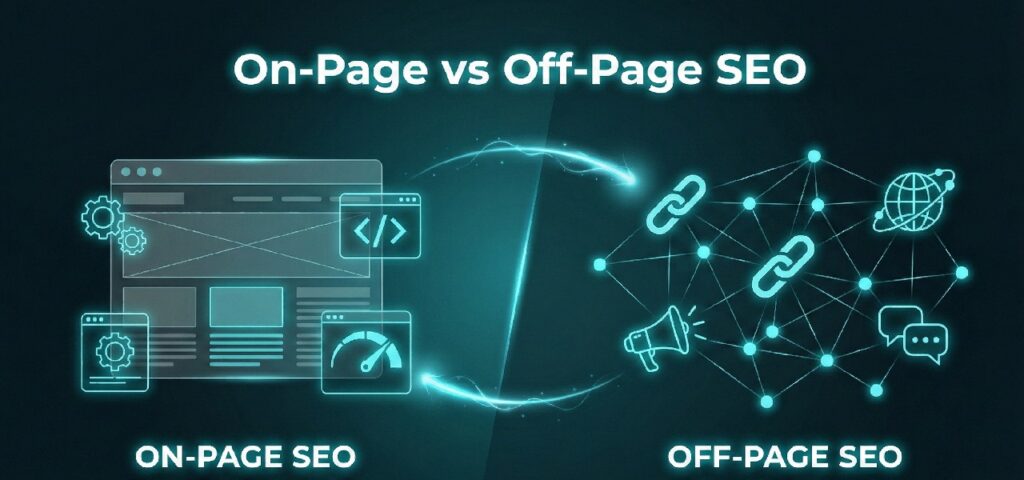
Search engine optimization (SEO) often feels like a black box of technical jargon and shifting algorithms. However, almost every ranking factor falls into one of two categories: on-page vs off-page SEO. Understanding how these two distinct yet connected pillars work is the first step to turning a chaotic marketing plan into a reliable revenue engine.
At its simplest, the difference between on page and off page SEO comes down to control. On-page optimization involves everything you can change directly on your website: your content, code, speed, and structure. Off-page optimization involves variables outside your website that influence your reputation, such as backlinks, social signals, and brand mentions.
Many businesses make the mistake of hyper-focusing on one while ignoring the other. A technically perfect site with no authority won’t rank, just as a popular site with broken navigation and thin content will struggle to convert traffic. When evaluating the types of SEO on page and off page, it is crucial to view them not as competing strategies, but as two sides of the same coin.
At Occam Digital, we believe that effective SEO shouldn’t be a guessing game. It requires a balanced approach where technical precision meets real-world authority. This guide breaks down exactly what is on page and off page optimization, how they influence Google’s decision-making, and how you can structure a strategy that prioritizes the right actions at the right time.
What’s the Difference Between On-Page and Off-Page SEO?
To build a sustainable strategy, you must first understand where the lines are drawn. While both aim to improve rankings, they target different parts of the search engine algorithm.
Simple Definitions With Real-World Context
The easiest way to visualize the distinction is to think of your website as a physical retail store.
On-page SEO is everything that happens inside the building. It includes the layout of the aisles, the clarity of the signage, the quality of the products on the shelves, and how quickly the checkout line moves. You optimize these elements to ensure that once a customer (or search crawler) enters, they can find exactly what they need without frustration.
Off-page SEO represents the reputation of that store in the wider community. It is the word-of-mouth recommendations, mentions in local newspapers, and reviews from past customers. These external signals tell the search engine that your store is reputable, popular, and worth recommending to new visitors.
Which Aspects Are In Your Control?
This is the most critical operational difference. On-page SEO relies on factors strictly within your control. If a title tag needs changing or a page loads slowly, you (or your developer) can log in and fix it immediately. The feedback loop is short and direct.
Off-page SEO relies on the actions of others. You cannot force a high-authority website to link to your content, nor can you force a customer to leave a glowing review. You can only influence these outcomes through high-quality content, outreach, and brand management. Because you lack direct control, off-page efforts often require more time and consistency to yield results.
Comparison Table: On-Page vs Off-Page SEO Side-By-Side
| Feature | On-Page SEO | Off-Page SEO |
| Primary Focus | The Website Itself | The Website’s Authority |
| Control Level | 100% Direct Control | Indirect Influence |
| Key Actions | Content, HTML tags, Site Speed | Link Building, PR, Social Shares |
| Target Audience | Search Bots & Site Visitors | Influencers, Publishers, Users |
| Search Goal | Relevance & Usability | Trust, Authority & Popularity |
How Search Engines Evaluate Each Type
Google’s algorithm uses thousands of signals, but they generally split into relevance and authority.
When evaluating on-page signals, search engines look for relevance. They scan your text, headers, and images to understand the topic of the page and match it to a user’s search query. If you want to rank for “financial services SEO,” your on-page content must explicitly and implicitly demonstrate that you cover that topic.
When evaluating off-page signals, search engines look for authority. They analyze the quantity and quality of links pointing to your site to determine if you are a trusted source. You might have the most relevant article on the web, but without the off-page signals to back it up, Google may prioritize a competitor it “trusts” more.
Key Elements of On-Page SEO
Because you have complete control over this environment, on-page optimization is the logical starting point for any campaign. It ensures your site is visible, readable, and valuable to both users and search engines.
On-Page SEO Checklist
Before launching a new page or auditing an existing one, ensure these foundational elements are in place:
- High-quality, intent-matched content
- Optimized Title Tags and Meta Descriptions
- Clean URL structure
- Logical Header hierarchy (H1, H2, H3)
- Internal links to relevant pages
- Image alt text
- Mobile responsiveness
- Fast loading times
Content Quality and Keyword Usage
Content is the primary vehicle for ranking. However, modern SEO has moved past simple keyword repetition. Google’s helpful content systems prioritize depth, expertise, and user intent. Your content needs to solve the user’s problem better than the current top-ranking results. While you must include your primary keywords naturally, the focus should remain on readability and providing comprehensive answers.
Meta Tags, Headers, and URLs
These HTML elements communicate the context of your page to search crawlers.
- Title Tags: This is the clickable headline in search results. It must be catchy, accurate, and include your main keyword.
- Headers (H1-H6): These structure your content. An illogical hierarchy confuses bots and readers alike.
- URLs: Keep slugs short and descriptive. Avoid long strings of numbers or irrelevant parameters.
Mobile Performance and Page Speed
With Google’s mobile-first indexing, the mobile version of your site is the primary version used for ranking. If your site is slow to load or difficult to navigate on a smartphone, your rankings will suffer regardless of how good your desktop site looks. Tools like Google PageSpeed Insights are essential for diagnosing these technical bottlenecks.
Internal Linking and Site Structure
Internal linking allows you to guide users and bots to your most important pages. It creates a hierarchy of information and distributes “link equity” throughout your domain. For example, if you offer SEO services, your blog posts should naturally link back to that service page where relevant. This signals to Google that the page is a pillar of your business.
Core Web Vitals and Page Experience
Core Web Vitals are a specific set of metrics Google uses to measure the actual user experience on your site. For business owners, these aren’t just technical scores. They are indicators of how frustrating or pleasant it is to interact with your website.
- Largest Contentful Paint (LCP): This measures loading performance, specifically how long it takes for the largest image or text block to appear.
- The Business Impact: If a potential client stares at a blank white screen for more than 2.5 seconds, they are likely to bounce back to Google and click on a competitor.
- Interaction to Next Paint (INP): This measures responsiveness, or how quickly your site reacts when a user clicks a button or taps a menu.
- The Business Impact: If a user clicks “Submit” or tries to open the navigation menu and nothing happens for a second, they assume your site is broken. High INP leads to abandoned sessions.
- Cumulative Layout Shift (CLS): This measures visual stability, tracking how much the page layout jumps around while loading.
- The Business Impact: We’ve all experienced trying to read an article only for an ad or image to load and push the text down. This annoyance kills credibility and user trust instantly.
Persistently poor Core Web Vitals can hurt your rankings because Google uses them as a signal of frustrating user experience.
Key Elements of Off-Page SEO
Once your website is optimized, you must prove to search engines that your content is trustworthy. This is where off-page SEO comes in. It acts as a system of votes and endorsements from the rest of the web.
Off-Page SEO Checklist
To build authority and trust, focus on these external factors:
- High-authority backlinks from relevant sites
- Consistent business listings (citations)
- Positive customer reviews (Google, Yelp, Trustpilot)
- Brand mentions (linked and unlinked)
- Social media engagement
- Guest posting and thought leadership
Backlink Quality and Domain Authority
Backlinks remain one of the strongest ranking signals in Google’s algorithm. However, quality far outweighs quantity. A single link from a high-authority industry publication or a university (.edu) is worth more than hundreds of links from low-quality directories. Search engines view these links as votes of confidence. If trusted sites link to you, your site is likely trustworthy as well.
Digital PR and Brand Mentions
Modern SEO relies heavily on brand signals. Digital PR involves getting your business featured in news outlets, industry blogs, and podcasts. Even if a publication mentions your brand without a hyperlink (an “unlinked mention”), Google’s advanced algorithms can associate that mention with your entity, strengthening your authority.
Local SEO, Citations, and Reviews
For businesses serving a specific geographic area, off-page signals are critical. This includes maintaining an optimized Google Business Profile and ensuring your Name, Address, and Phone number (NAP) are consistent across all directories. Managing reviews is equally important; a steady stream of positive feedback signals to Google that your business is active and reliable. This is a foundational step for small business SEO strategies where local competition is fierce.
Social Signals and Audience Engagement
While social media shares are not direct ranking factors, there is a strong correlation between social popularity and search rankings. Viral content attracts traffic, and increased traffic often leads to more backlinks and brand searches. An active social presence validates your brand’s existence and helps distribute your content to people who might link to it later.
When to Prioritize On-Page vs Off-Page SEO
A common question from business owners is, “Where do I spend my budget first?” The answer depends on the maturity of your website, but there is a logical order of operations.
Foundational SEO: What Must Come First
On-page SEO always comes first. You cannot effectively market a website that is fundamentally broken or empty. Before you spend a dollar on PR or link building, your “house” must be in order.
Think of it this way: Off-page SEO is like inviting guests to a party. On-page SEO is cleaning your house and preparing the food. If you invite people over (build links) to a messy house with no food (bad content/technical errors), they will leave immediately, and your reputation will suffer.
Focus on these quick wins first: fixing broken links, speeding up the site, and ensuring your service pages clearly explain what you offer.
How to Know When Your On-Page is “Done”
Technically, SEO is never “done,” but your on-page efforts reach a point of diminishing returns. You are ready to shift focus to off-page strategies when:
- Technical Health is Green: Crawl errors are close to zero, and Core Web Vitals are passing.
- Content is Comprehensive: Your main service and product pages are written, optimized, and better than your competitors’.
- User Experience is Smooth: Navigation is intuitive, and the mobile experience is flawless.
Once this foundation is solid, endless tweaking of meta tags will yield less value than earning a single high-quality backlink.
When Off-Page Efforts Move the Needle
Off-page SEO becomes the priority when you are stuck. If your pages are perfect, your content is excellent, but you are still stuck on page 2 or at the bottom of page 1, the missing ingredient is usually authority.
In competitive industries, everyone has good on-page SEO. The tie-breaker is off-page authority. If you are competing against established giants, you need to aggressively pursue digital PR, guest posting, and reviews to signal to Google that you belong at the top table.
How On-Page and Off-Page SEO Priorities Vary by Industry
While the principles remain the same, the balance between on-page and off-page efforts changes depending on your business model.
E-commerce: Product Pages, Structured Data, and Reviews
For online stores, on-page SEO is technically demanding. You must manage thousands of product pages, ensuring unique descriptions and implementing schema markup (structured data) so prices and ratings appear in search results. However, off-page signals like customer reviews and influencer mentions are what drive the trust needed to make a purchase. This unique interplay underscores the importance of SEO for E-commerce.
- Focus: Roughly 60% On-Page (Architecture & Content), 40% Off-Page (Reviews & PR).
If you sell online and want a clear plan for product page SEO, schema, and review-driven trust signals, our e-commerce SEO services cover the full setup—from templates and structured data to category strategy and technical fixes.
SaaS: Content Marketing, Link Building, and Authority
Software companies rarely have physical locations, so local SEO is irrelevant. Instead, the battle is fought over informational keywords. On-page efforts focus on high-utility blog content and pillar pages. Off-page efforts focus heavily on acquiring backlinks from reputable tech publications to prove software legitimacy.
- Focus: Approximately 50% On-Page (Education), 50% Off-Page (Authority Building).
Local Businesses: Google Business Profile and Citations
For plumbers, lawyers, or restaurants, off-page SEO is often the dominant driver of revenue. A well-optimized site matters, but ranking in the Local Pack is heavily driven by your Google Business Profile, reviews, citations and proximity, with on-site relevance supporting those signals.
- Focus: About 30% On-Page (Location pages), 70% Off-Page (GMB, Reviews, Citations).
Our local SEO services help you strengthen those off-page signals by optimizing your Google Business Profile, building consistent citations, and improving review velocity—while keeping your site aligned with local intent.
News/Media: Page Speed, Freshness, and Backlinks
For news publishers, speed is everything. On-page optimization ensures that articles index instantly and load immediately on mobile devices. Off-page SEO happens naturally as other sites cite your breaking news, but you must maintain technical excellence to handle the crawl volume.
- Focus: Around 80% On-Page (Technical & Speed), 20% Off-Page (Natural Link Growth).
Regulated Industries: Healthcare, Finance, and Legal
In industries where bad advice can harm a user’s health or wealth (known as YMYL: Your Money Your Life), Google’s standards are incredibly high. On-page content must be factually perfect and written by experts. However, off-page signals are the primary way Google verifies that expertise. As demonstrated in our work with SEO for financial services, you benefit massively from links from accredited institutions, industry associations, and major publications to validate your standing.
- Focus: High stakes on both. Content must be flawless, and authority must be verifiable.
Why Both Are Essential for Long-Term SEO Success
Treating on-page and off-page SEO as separate siloes is a recipe for stagnation. To dominate search results in 2026, you need to understand how they amplify each other.
How They Work Together in Google’s Ranking Signals
Think of your website as a high-performance car.
- On-Page SEO is the engine. It determines how fast the car can go. If your engine is broken (technical errors) or small (thin content), you won’t go anywhere.
- Off-Page SEO is the fuel. It provides the power to move the car forward. You can have a Ferrari engine, but without fuel (authority/backlinks), it sits in the garage.
Google wants to rank “fast cars with full tanks”: sites that are technically sound, highly relevant, and widely trusted.
Risks of Focusing on One and Ignoring the Other
Imbalance leads to predictable failures:
- The “Ghost Town” (All On-Page, No Off-Page): You have a beautiful website, perfect code, and amazing articles, but zero traffic. You are the best-kept secret in your industry because Google doesn’t trust you enough to rank you above established competitors.
- The “House of Cards” (All Off-Page, No On-Page): You have aggressive link building and PR, but your site is slow and the content is thin. You might spike in rankings temporarily, but users will bounce immediately, and Google will eventually drop you for providing a poor experience.
How Occam Digital Balances Both in Real Campaigns
At Occam Digital, we don’t believe in cookie-cutter packages. We’ve seen firsthand that a “one-size-fits-all” approach fails because every business has a different bottleneck.
For our clients in highly regulated sectors like finance, we often dedicate the initial phase of the campaign almost exclusively to on-page excellence: auditing compliance, structuring data, and verifying expert-led content. Only once that foundation is rock-solid do we shift focus to building external authority.
Conversely, for established e-commerce brands that already have thousands of products, on-page tweaks often yield diminishing returns. In those cases, we pivot immediately to strategic brand building and digital PR, securing genuine reviews and high-tier media placements to distinguish them from competitors. The secret isn’t doing everything at once; it’s doing the right thing at the right time.
Final Thoughts: A Balanced SEO Strategy Brings Peace of Mind
SEO doesn’t have to be a source of anxiety. When you strip away the buzzwords, it is simply a process of making your business valuable (On-Page) and proving that value to the world (Off-Page).
Why Smart SEO Starts With Clarity, Not Complexity
The businesses that win in search aren’t the ones chasing every algorithm update. They are the ones that build a solid foundation. They ensure their digital storefront is welcoming and efficient, and they consistently build their reputation in their industry.
Occam Digital’s Approach: Simplifying for Impact
We know that as a business leader, you don’t need another 50-page audit filled with technical warnings; you need a clear path to revenue. Whether you need to fix a broken foundation or amplify a successful brand, we help you identify the lever that moves the needle.
If you are unsure which half of your SEO strategy is holding you back, contact us today. Let’s stop guessing and start building a strategy that ranks.
FAQs About On-Page and Off-Page SEO
Do I need both on-page and off-page SEO to rank well?
Yes. In non-competitive niches, you might rank with just excellent on-page content. However, for any search term with commercial value, you will need a combination of relevance (on-page) and authority (off-page) to reach the top three positions.
Which should I focus on first if I’m just starting SEO?
Always start with on-page SEO. It is cheaper, faster, and entirely within your control. Build a high-quality site that deserves to rank before you spend time and money trying to build authority for it.
How can I tell if my current SEO is missing something?
Check your traffic and rankings.
- If you rank on Page 2 or 3 but can’t move up, you likely lack off-page authority (backlinks).
- If you rank well but don’t get clicks, your on-page metadata (titles/descriptions) might be weak.
- If you get clicks but users leave immediately, your on-page content or speed is likely the issue.
Is technical SEO part of on-page SEO?
Yes, most definitions include technical SEO (site speed, mobile friendliness, indexing) under the umbrella of on-page SEO because it involves changes made directly to your website.
Can I handle on-page SEO myself or should I hire an agency?
Many business owners handle basic on-page SEO (content writing, title tags) themselves. However, complex technical issues and large-scale off-page campaigns (like digital PR and link building) are time-consuming and often require the relationships and tools of a specialized agency.